This page contains affiliate links. If you purchase through them we may earn a small commission at no extra cost to you. Learn more
MCS Redeveloped Installer Scheme 2026: What Homeowners Should Ask
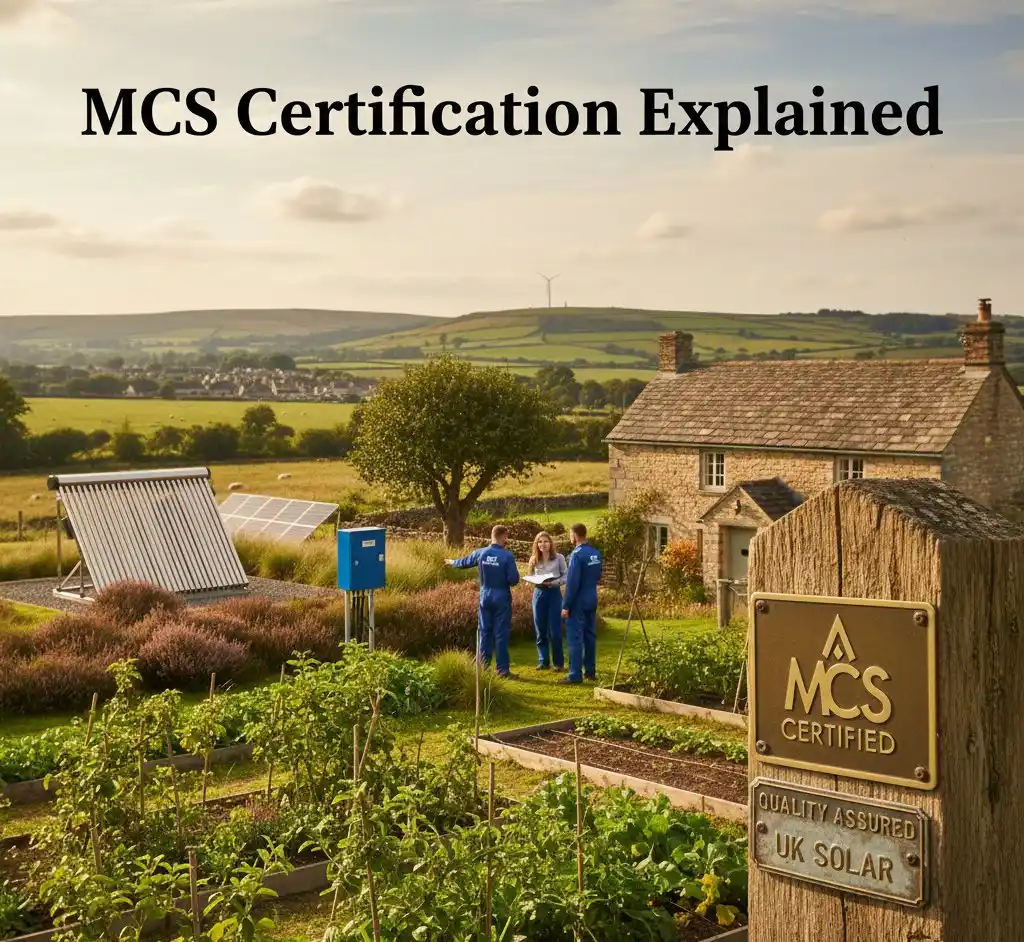
If you are getting solar panel or heat pump quotes in 2026, you will keep seeing the phrase MCS-certified installer. The label still matters, but the paperwork behind it is changing.
In one sentence: MCS is the UK quality scheme that checks renewable installers, products, and installations against recognised standards so consumers, energy suppliers, and grant schemes can rely on the work.
For market context, see UK solar statistics 2026. The UK passed 2 million solar installations in March 2026, so installer quality now affects a large market.
What changed in 2026?
MCS says certification bodies will support installers to move onto the redeveloped scheme in phases, with most installers moving over throughout 2026 (MCS, mcscertified.com, fetched 2026-04-24).
Before the redevelopment, the installer framework was often explained through separate pieces: competency under MCS 025, contractor quality management under MCS 001, and consumer protection through a consumer code plus an Insurance-Backed Guarantee. Those ingredients have not vanished, but the scheme is now being presented under one clearer structure.
The headline change for homeowners is the consumer-protection layer around the installer. MCS now points to a formal financial protection area, with requirements for Financial Protection Providers and a list of MCS-approved financial protection products (MCS, mcscertified.com, fetched 2026-04-24).
MCS also lists an MCS Certification Fund under installer grants and incentives. Treat this as installer-side support, not a consumer grant. If you are looking for help with costs, start with solar panel grants UK instead.
2026
phased move to the MCS Redeveloped Installer Scheme for most certified installers
Choose an installerPre-redevelopment vs redeveloped scheme
Here is the practical version for a homeowner comparing quotes.
The useful shift is visibility. You should be able to ask where the workmanship warranty, IBG, complaints route, and MCS certificate sit, without decoding several acronyms.
What to ask an installer in 2026
Start with the normal checks in how to choose a solar installer: MCS status, written quote, exact equipment, workmanship warranty, DNO handling, and aftercare.
Then add these 2026-specific questions:
-
Are you moving over to the MCS Redeveloped Installer Scheme?
Existing installers may still be in transition, but they should be able to explain where they are in the process. -
Which financial protection product backs my workmanship warranty?
Ask for the Insurance-Backed Guarantee details in writing. Then check whether the insurer or product appears on the MCS-approved financial protection products list. -
Does RECC or HIES apply to this contract?
The MCS redeveloped scheme page says consumer code membership is no longer mandatory as a scheme change (MCS, mcscertified.com, fetched 2026-04-24). If the installer says RECC or HIES applies, ask for the membership number and complaints route. -
Which certificate and handover documents will I receive?
You still need the MCS installation certificate for Smart Export Guarantee applications, most grant routes, and future property paperwork. For the step-by-step handover list, see the solar installation process.
What this means for you
For a homeowner, the redeveloped scheme should make three things clearer.
First, the Insurance-Backed Guarantee should be easier to trace. If an installer stops trading, the IBG is the mechanism that keeps the workmanship warranty alive.
Second, it should be easier to see who is funding the financial protection product. An IBG is only useful if the provider is real, approved, and named in your paperwork.
Third, the language should become simpler over time. Instead of references to MCS 025, MCS 001, a consumer code, and a separate IBG list, you should increasingly see one MCS redeveloped scheme banner with supporting documents beneath it.
This does not mean every installer using older wording is doing something wrong. MCS says most installers are moving over throughout 2026, and no public close date surfaced in the MCS source trail reviewed for this article (MCS, mcscertified.com, fetched 2026-05-03). During that period, quotes, contracts, or emails may still mention MCS 025, MCS 001, RECC, HIES, or older IBG wording.
That is normal transition noise. The red flag is an installer who cannot explain their MCS status, their moving-over position, their IBG provider, or the complaints route attached to your contract.
If you are comparing quotes now, keep the practical test simple: active MCS status, clear contract, named financial protection, clear consumer route, and no pressure to sign before you have checked the documents.
Sources
The factual claims on this page are drawn from these primary sources. We maintain a full reference library of UK solar regulations, standards, and official statistics so every article is traceable.
- MCS News and Insights crawl, 17 April 2026 — Local raw source IWantSolar/raw/2026-04-17-mcs-news-insights.md captured MCS site navigation and redeveloped scheme links
- MCS Redeveloped Installer Scheme — Local raw source IWantSolar/raw/2026-04-24-mcs-redeveloped.md confirms the redeveloped scheme, moving-over guidance, financial protection pages, and 2026 phased transition
- MCS Latest News, fetched 3 May 2026 — Local raw source IWantSolar/raw/2026-05-03-mcs-news-insights.md confirms the 19 February 2026 redeveloped scheme news item and ongoing MCS activity
Share this article
Stay informed
Get free solar updates direct to your inbox
Related reading

UK Solar Panel Statistics 2026: The Numbers That Matter
UK solar statistics 2026. How many homes have solar, total capacity, growth rate, costs over time, and what it means for you.

Solar Panel Grants and Funding UK 2026
A plain-English guide to every solar grant, scheme, and funding route available in the UK in 2026 — including ECO4, GBIS, HUG2, BUS, and devolved schemes.


Switch to Octopus Energy
Get 50 credit when you switch. We get 50 too — win-win.

Prefer 100% renewable, community-owned?
Your Co-op Energy runs on 100% renewable electricity — profits reinvested in community energy projects.
What does this mean for YOUR home?
Design your perfect solar setup in under 3 minutes. Free, no sign-up required.
Build Your Solar System